Research Projects
Current Projects
PhD Research: Reinforcement Learning for Understanding Motor Control and Decision Making
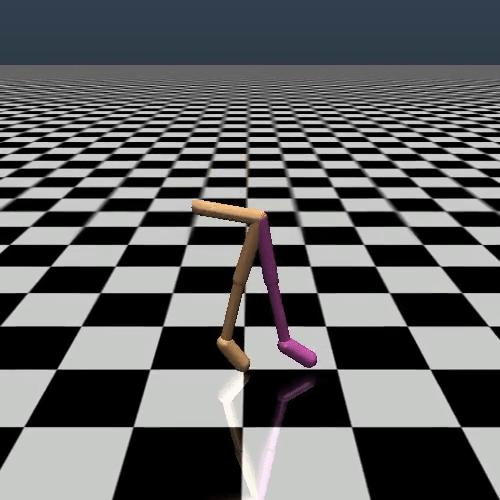
How do humans learn to move, make decisions, and adapt their behavior to changing environments? This research investigates these questions through reinforcement learning (RL) and inverse reinforcement learning (IRL), using computational models to better understand the learning and decision-making mechanisms of the brain. While reinforcement learning focuses on acquiring behavior through rewards and experience, inverse reinforcement learning approaches the problem from the opposite direction, inferring the underlying objectives and preferences that drive observed behavior. We apply these methods to human motor control and cognitive decision-making, investigating how humans balance competing objectives, such as effort and safety, when adapting their movements.
Another direction of this research explores biologically inspired reinforcement learning, aiming to bridge the gap between artificial learning algorithms and the mechanisms of learning in the brain. We investigate neural plasticity, activity-dependent learning, and structural credit assignment to develop learning mechanisms that selectively regulate when and where learning occurs within neural networks. By combining insights from neuroscience with modern reinforcement learning, our broader goal is to develop computational models that both explain biological behavior and enable more efficient, adaptive, and biologically plausible artificial learning systems.
Master’s Thesis: Context-Based Echo State Networks for Bimanual Robotic Surgical Suturing
This research investigates the application of Context-Based Echo State Networks (CESNs), a reservoir computing approach, to learning and controlling complex bimanual robotic manipulation tasks in surgical environments. Using two Franka robotic manipulators in NVIDIA Isaac Sim, we focus on surgical needle handover and suturing, where precise coordination, temporal dependencies, and adaptation to changing task conditions are essential. The project aims to develop a computationally efficient learning framework that integrates task context, robot states, and sensory feedback to learn coordinated motion and control policies from demonstrations. By leveraging the temporal dynamics of reservoir computing, we investigate whether CESNs can capture complex manipulation behaviors while reducing the computational demands associated with conventional deep learning approaches. The broader goal is to enable efficient, adaptive, and generalizable learning of sensorimotor skills for robotic surgical assistance.
Efficient Behavioral Cloning
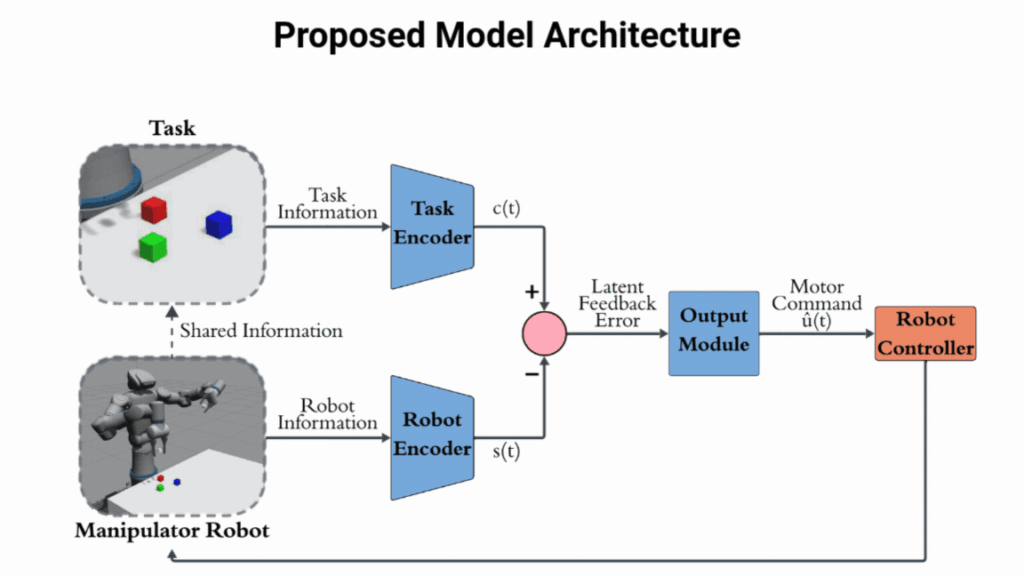
Learning from Demonstration (LfD) enables robots to acquire new behaviors from demonstrations, with Behavior Cloning (BC) providing a straightforward approach to learning mappings from states to actions. In this project, we develop a parameter-efficient BC framework inspired by the error-driven structure of classical feedback control. The framework computes a latent feedback error between task and robot representations and uses this error to generate joint-space actions.
The proposed architecture is motivated by the idea that learning models whose structures align with the underlying data-generating processes can achieve better learning efficiency and generalization. Assuming that human demonstrations used in LfD are generated by feedback control mechanisms, we hypothesize that a BC model incorporating a feedback control structure can outperform a controller-agnostic alternative. We evaluate the proposed framework on a multi-step block-stacking task with two levels of configuration complexity, in both simulation and real-robot experiments.
VLM Guided Exploration for Action-Effect Learning
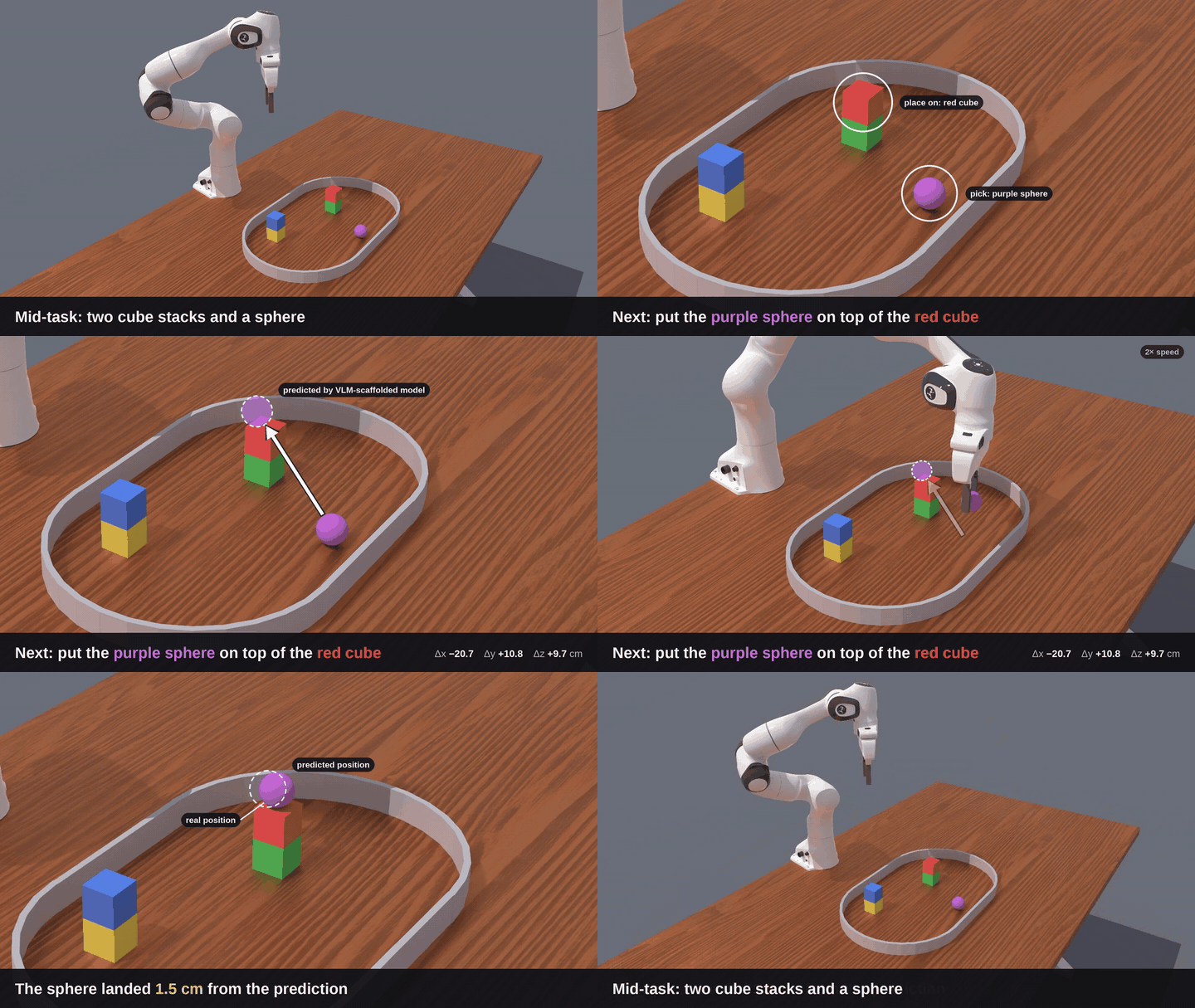
Robots learn about their environment by interacting with it and observing the resulting changes. Through this experience, they can learn action-effect prediction: predicting how a given action will change the environment from its current state. Learning these predictions depends on the interactions a robot experiences. However unguided exploration might repeatedly produce similar interactions while rarely reaching configurations that offer richer learning opportunities.
We use Vision Language Models (VLMs) to provide scaffolding for robotic exploration guiding robots toward diverse object interactions and configurations difficult to reach through unguided exploration. We investigate how this guidance influences the experiences collected and how that experience supports learning to predict action-effects. Our broader goal is to enable robots to acquire predictive models of their environment that can support future planning and action.
ARBOR: Adaptive Reservoir Bootstrapping of Repertoires
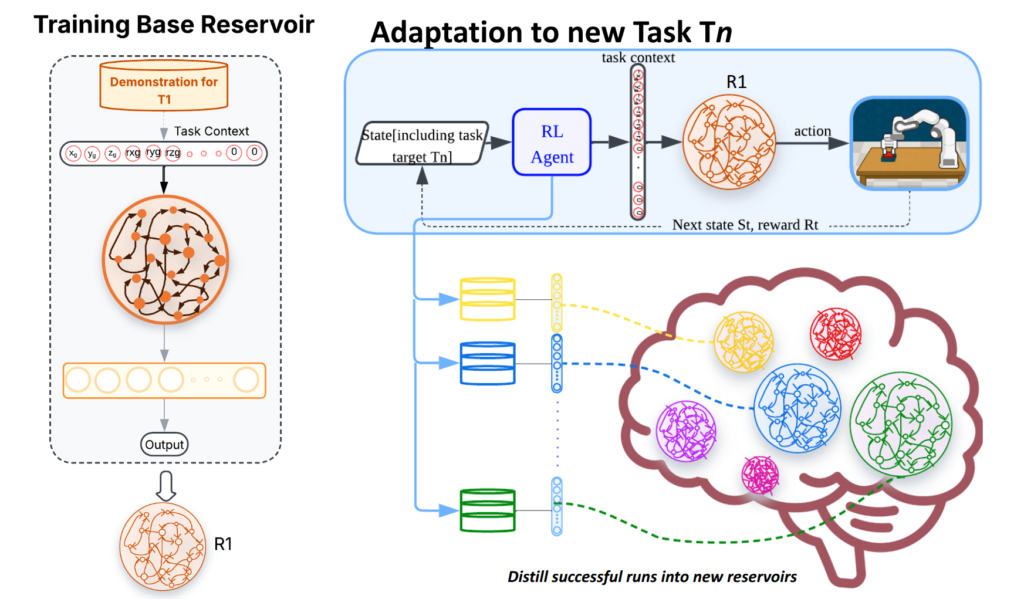
Humans rarely learn a new motor skill from scratch. Instead, they recruit a skill they already have, adapt it to the new demand, and with practice the adapted behavior becomes a skill in its own right. ARBOR brings this idea to robot learning by using reservoir computing to grow a repertoire of manipulation skills from a single demonstration. A base reservoir is first trained on a demonstration of a simple reaching task and then permanently frozen. New manipulation tasks are then acquired without changing the reservoir itself. A reinforcement learning agent learns to modulate the context input to the frozen reservoir, writing into input slots the base task left unused. This keeps the search space independent from the task difficulty.
Data from successful runs is used to train a new readout or a new reservoir, producing a dedicated reservoir that solves the new task on its own. Each new reservoir joins the growing repertoire. We investigate how far a single demonstration can be stretched through this process, and which kinds of new tasks inherited skills can and cannot support. Our broader goal is to enable robots to build an ever-growing set of skills efficiently, much as humans build new abilities on top of the ones they already have. This research is conducted in collaboration with Dr. Jihoon Park, University of Osaka.
PETITE: Improving Peer-Tutoring-Inspired Multi-Agent Code Generation
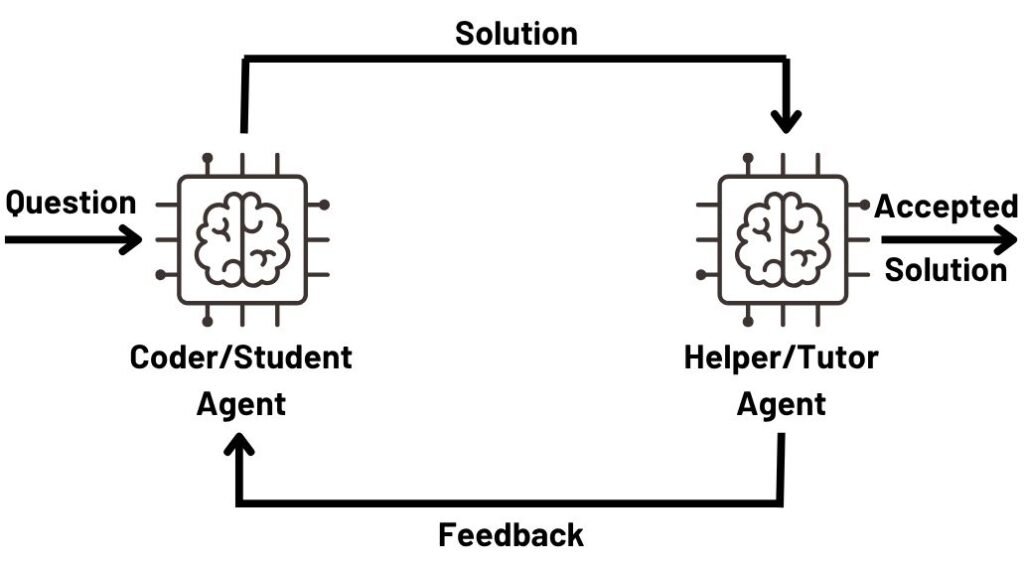
PETITE is a multi-agent LLM framework for code generation inspired by human peer tutoring. It was presented at IEEE ICDL 2026, where it showed better results against relative algorithms and frameworks. The current phase of the project aims to make PETITE more reliable, more efficient, and better at knowing when a solution is finished.
Inter-agent communication: Exploring alternatives to free-form natural language between agents, and ways to make natural-language exchanges more precise.
Error detection and recovery: Predicting when an agent has hallucinated or gone off track and retrying only the failed step instead of restarting the whole process. This includes building a classification of failures, separating coding errors from LLM reasoning errors.
Smarter early stopping: Measuring how individual signals predict a correct solution, including error class, the agents’ own stopping judgment, confidence in correctness, estimated problem difficulty, and test results from an independent third model. These are then combined into a single stopping criterion and evaluated on the full benchmark.
Prompt and refinement design: Optimizing system and task prompts on controlled single-case tests, and extending the iterative refinement loop to new models.
A version of PETITE that solves more problems at lower cost by stopping at the right time, recovering from errors locally, and communicating more effectively between agents.
Undergraduate Thesis Project: Robot Learning for Robotic Surgical Thread Cutting
The project aims to focus on the problem of simulated and real-world performance of robots, which is called simulation to real (sim-to-real) gap, with the planned outcome of a learning pipeline for cutting surgical thread tasks in medical robotics. NVIDIA Isaac Sim for simulation, NVIDIA Isaac Lab for developing, training and testing control policies; Python and C++ for controlling and robot learning inside of Isaac Lab, custom 8 DOF (Degrees of Freedom) robotic manipulator for conducting tasks, ROS2 for controlling the robot is used for the project.
Past Projects
Master’s Thesis: Reservoir Computing for Efficient and Effective Learning
This master’s research focused on Reservoir Computing. While traditional learning algorithms inherently perform both representation and learning, this paradigm uniquely outsources the representation phase to a dynamical system. Bedirhan worked on making these systems more efficient by generating higher-order interactions among their units to increase algorithmic performance. By establishing this divide, Reservoir Computing holds strong promise for the future of our field paving the way for algorithms that are robust, powerful, and highly resource-efficient, operating much like the 20 watts of power required by the human brain.
Sign Representation of Boolean Functions
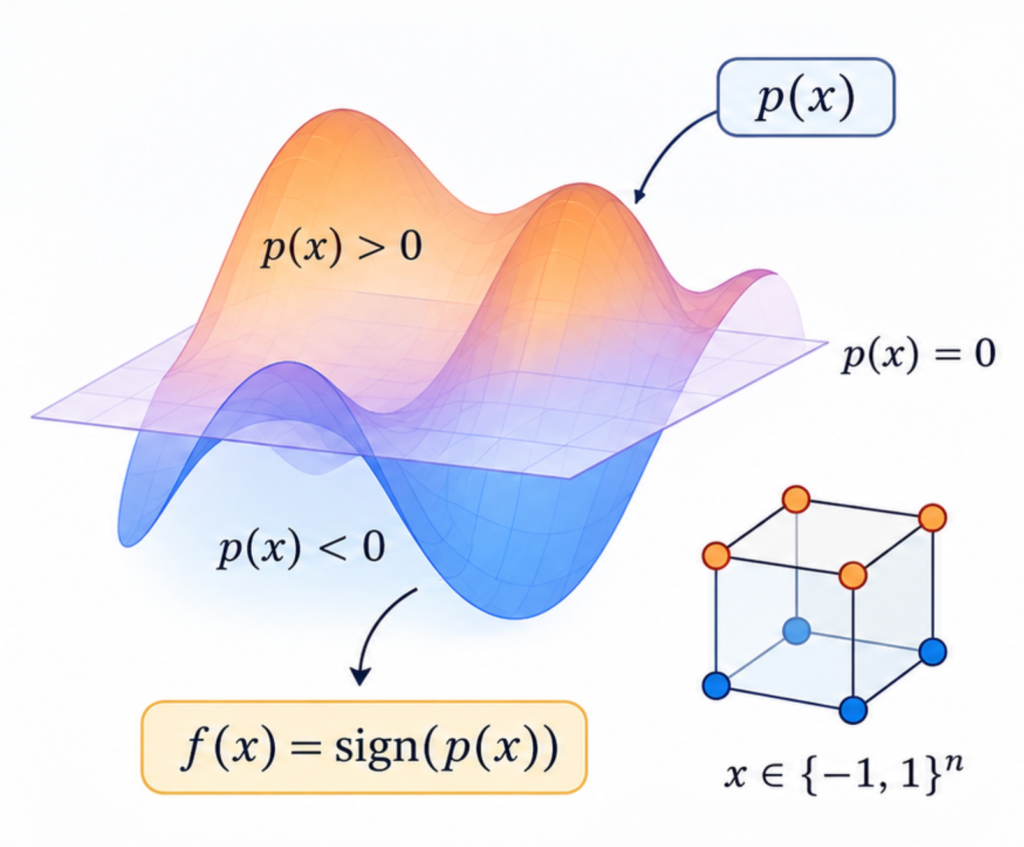
Boolean functions play a fundamental role in computational complexity, learning theory, and the mathematical foundations of artificial intelligence. This project investigates their representation by polynomial threshold functions, where a Boolean function is expressed as the sign of a real-valued polynomial. Our primary focus is on representation sparsity: determining how few polynomial terms are sufficient to represent a given Boolean function and understanding the structural properties that govern this minimum.
We combine theoretical analysis with computational exploration to develop new bounds, characterize minimum-density representations, and investigate the relationship between polynomial support and the Fourier spectrum of Boolean functions. Particular attention is given to balanced Boolean functions, bent functions, and longstanding open questions such as Saks’ problem concerning the support of minimum-density sign representations. The broader objective is to advance our understanding of Boolean function complexity and its connections to efficient computation and learning.
Human-Like Facial Expressions in Android Robots: Generation and Perception
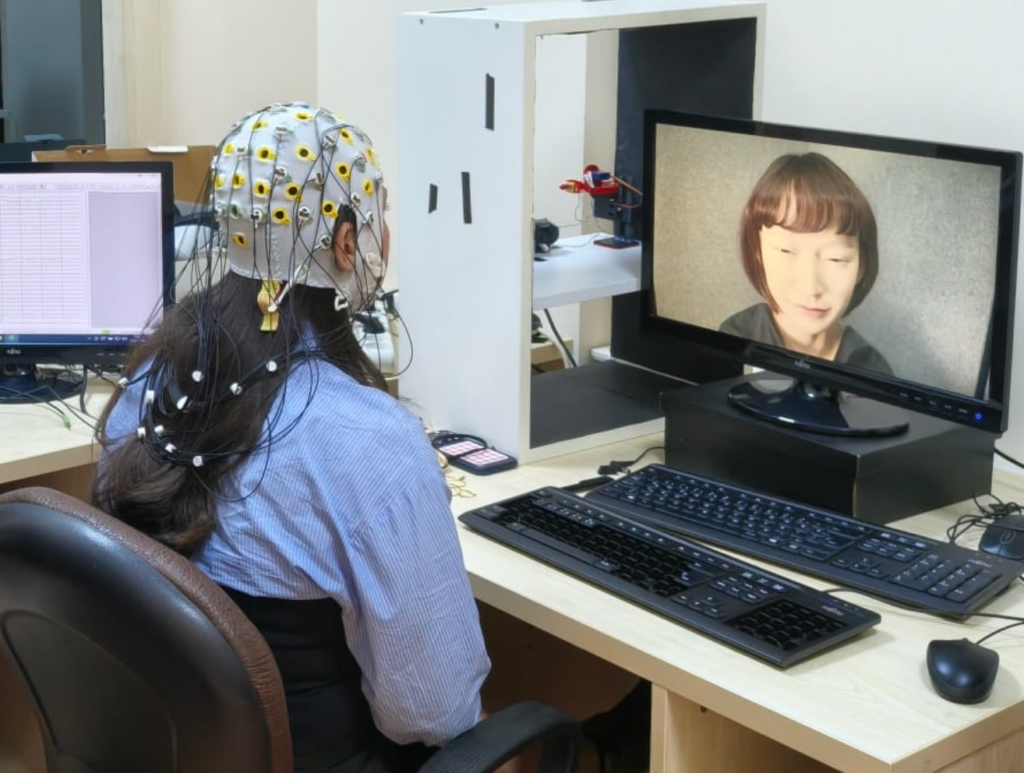
This project aims to develop realistic and meaningful facial expressions in android robots and understand how humans perceive and respond to them. Human-like facial expressions require not only accurate facial configurations but also natural temporal dynamics that convey emotions and internal states. We investigate how the physical appearance and movement characteristics of android faces influence emotion recognition, perceived naturalness, and human-likeness, using behavioral and neuroscientific methods, including electroencephalography (EEG). One direction is to use human-in-the-loop learning methods for generating expressive android behavior. By incorporating human perceptual judgments and physiological responses into the learning process, we aim to optimize facial-expression controllers that produce recognizable, natural, and socially appropriate expressions. Ultimately, this research seeks to bridge the gap between artificial and human facial expressivity, enabling more intuitive and effective human–android interaction. This research is conducted in collaboration with Hisashi Ishihara, Ritsumeikan University and Minoru Asada, the University of Osaka and Evrim Oztop, Akdeniz University.
 ” alt=”Describe the project photo” loading=”lazy”
style=”display: block; width: 100%; height: 100%; object-fit: contain;”>
Neurosymbolic Learning
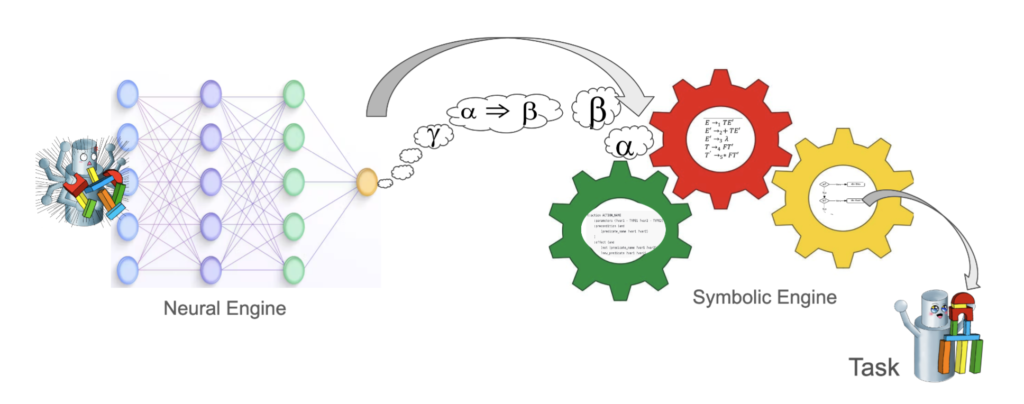
This project investigates neurosymbolic learning, combining the adaptability and generalization capabilities of neural networks with the structured representations and reasoning mechanisms of symbolic AI. Our goal is to develop intelligent systems that can acquire knowledge from experience, reason about their environment, and adapt their behavior to new tasks and situations. By integrating continuous sensorimotor representations with discrete concepts and relational knowledge, we aim to bridge the gap between low-level perception and high-level cognition. Our research focuses on learning structured representations, integrating neural and symbolic reasoning, and developing architectures that support compositionality, continual learning, and knowledge reuse. We are particularly interested in applying these principles to cognitive robotics, where intelligent agents must connect perception, reasoning, planning, and action to operate flexibly in complex and changing environments. This work is in collaboration with Prof. Dr. Emre Uğur, Middle East Technical University.